Will Microsoft? "Wal-Mart? "General Electric? "ExxonMobil? "PetroChina? Nonsense. If those people you think is important is because they know them.
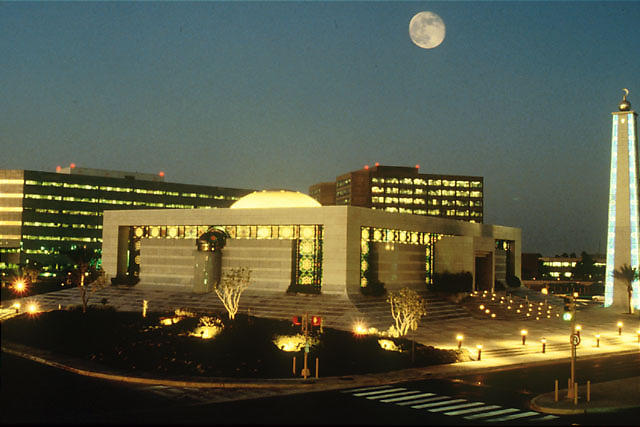
headquarters of Saudi Aramco in Dhahran. In the foreground, the mosque
Al-Mujjama. Back to the left., The building engineering, and the right., the
two towers that house the administration.
God, Fatherland, King Company.
Saudi Arabia is an absolute monarchy in the traditional style, where religion, state, the royal family and Saudi Aramco are an inseparable and indistinguishable. Four times larger than Spain, occupying most of the Arabian Peninsula, halfway between the Red Sea and the Persian Gulf. However, its population is relatively low (twenty-eight million, of which 5.5 million are foreign immigrants) is concentrated mainly in the capital Riyadh and in a narrow strip along the west coast that extends from Jizan in the south, to Jeddah, Mecca and Medina in the north. Most of the country is largely uninhabited, it is occupied by the Arabian Desert. This wilderness contains some of the most alien on planet Earth, as the disturbing Rub 'al-Khali, the empty place .

The conflict had a religious component. The Shiites were fairly common Rasheed, the House of Saud, Sunnis in a particularly strict and reactionary version known as Wahhabism (although they prefer the term Salafism ). Wahhabism or Salafism is one more of the assumptions returns to the roots that religions arise from time to time, to some extent similar to the ultra-conservative branches of Protestant Christian clergy reaction against corrupt and innovations (such as Sufism ), literalism and inerrancy of their sacred book (For about the Bible and the Qur'an others), defense of religious purity and traditional family values, opposition to idolatry (including images, monuments and icons), radical opposition to any form of popular or traditional religion (magic talismans, etc), denounces the cult of saints or other intermediary to their god, as well as severe moral puritanism, social and sexual gender and class elements very strong.

1. The Kingdom of Saudi Arabia is a sovereign Arab Islamic state, and Islam is their religion. Its constitution is the Book of God [the Koran] and the Sunnah [tradition] of His Prophet [Muhammad], that prayers and peace of God be upon him. Arabic is its language and Riyadh, the capital.
2. The state's public holidays are Id al-Fitr and Id al-Adha [the last day of Ramadan and the celebration of the sacrifice of Abraham]. Your calendar is the Hijri calendar.
3. The state flag shall be as follows: (a) is green [the color of Islam], (b) its width is equal to two thirds of its length, (c) the words "There is only one God and Mohammed is His Prophet" shall be entered in the middle with a sword at his feet [...]
[...] ... and follow a style for scores of the 83 items it contains. Private property is sacred (Articles 18 and 19), taxes are imposed only when there is a need (art. 20) and property, capital and labor are personal rights under the law of God (art. 17). With regard to the freedoms and democratic rights, however, only find the following:6. Citizens owe allegiance to the King in accordance with the Quran and the tradition of the Prophet, in submission and obedience, in easy times and difficult, fortune and adversity.
7. The Government of Saudi Arabia derives its power from the Holy Quran and the Prophet's tradition.
8. [The principles of the] Government of Saudi Arabia are based on justice, consultation and equality under the law of God [Shari'ah].
9. Family is the kernel of Saudi society and its members will be educated on the basis of the Islamic faith, loyalty and obedience to God, His Prophet and his guardians
12. The consolidation of national unity is a duty, and the State shall prevent anything that could lead to disunity, sedition and separation.
26. The state shall protect human rights according to God's Law [Shari'ah].
44. The state authorities are the judiciary, executive and regulatory authority. [...]
45. The judiciary is an independent authority except [...] regarding God's Law [Shari'ah].

No, obviously not lacking. The legislature is also focused on the royal family, the clergy (ulama ) to interpret the Divine Law and the judges who apply it. We are therefore faced with an absolutist theocracy medieval features, light years ahead of the French Revolution and what it meant. The rule of law is the rule of law of the king, the clergy and the homeland. God, Country, King. And Company.
black and gold American friend.
Since its origin, the history of Saudi Arabia is inextricably linked to oil that abounds in the sand seas inhóspitas.Ya in 1932, American geologists Standard Oil of California (now Chevron ) found oil in another de facto British protectorate located in the Arabian peninsula itself, or almost: Bahrain. In 1933, barely a year after the founding of the country, Saud granted a concession to the same oil company to drill in their territory. In 1936, the Texas Oil Company (now Texaco ) Standard Oil bought 50% of this award. In 1938 these companies opened the first field, precisely in Dhahran, which is now the headquarters of Saudi Aramco.
During the Second World War, such wells and marginally supported the Allied war effort. However, it was not until the end of it when these American companies began to fully exploit the oil wealth of the region as well, left in a distant second to their cousins \u200b\u200b British BP, which focused on the exploitation of Iranian wells. In 1944, Standard Oil changed its name to its local subsidiary, until then known Casoc or California Arabian Standard Oil Company - by Aramco, Arabian American Oil Company . In 1945, this opened the giant Aramco Ras Tanura refinery, which for many years would be the most in the world and still ranks fifth.

Arab-Israeli War of 1948 started to complicate things. In this war, both the U.S. and the Soviet Union sided with Israel and the Arabs were left alone, with the result that it can be assumed. Between this and the Yankees were being made of gold with Saudi oil without the House of Saud, were more leftovers in 1950 threaten to nationalize Aramco for the first time, mimicking what happened in Venezuela little earlier. In essence, they wanted 50% of the profits. ExxonMobil, Chevron Texaco and panicked and sought help from the United States government. President Truman gave it, and how: these oil companies guaranteed a tax of 50% of the profits on sales of fuel, so that he could give the other 50% to Ibn Saud without reducing their profits. The money was channeled directly through the Treasury of the United States. This privilege on a large scale is known as the Golden gimmick .
As in Saudi Arabia there is no separation between the monarchy and the state, all these immense riches were to actually stop the coffers of the royal family, which over the following years he became famous worldwide for luxurious lifestyle to absurd extremes. It is true-we must say in justice, who took advantage to lift the country, although in practice the country was theirs too. Similarly, oil-producing countries became aware of the huge profits they could get, and that until then had mostly these foreign companies, "so they began the movement to found the OPEC .
And the United States protected the House of Saud against all external and internal enemies, despite the problem with Israel. In exchange for this and its 50%, King continued shoving allowed Aramco to Saudi oil. Participated in the Six Day War, for that of solidarity among fellow Arabs, Muslims, etc., but reluctantly (and much less to help the Egyptians, with those who can not even see). However, the Yom Kippur War of 1973 quite complicated things: the warmth of rich Saudi state against the Zionist enemy began to be frowned upon throughout the Arab world and the royal family feared for their stability, but for Moreover, their hands were tied because the very American Aramco was the almost sole source of wealth for the country and its rulers.
Over the next seven years, the House of Saud (or state Saudi Arabia, which it does not matter) was increased by investing in the company. In 1980 bought the latest action, which the former U.S. Saudi Aramco became completely-that way, Riad recovered full control over its oil production and exports without relying on the United States. So, won more political freedom to move between the magazines of the Middle East and world markets.
However, the House of Saud never felt comfortable away from American friend, especially considering that their Egyptian rivals were moving away from the approaching Soviet Union and the United States. They did not want stop being the favorite of the West in the Arab world. Backroom, continued to cooperate at all levels. U.S. operations for create modern Islamic fundamentalism against the Soviet Union in Afghanistan and secular pro-Soviet regimes across the Middle East is implemented mainly through Saudi Arabia and Pakistan (those were the days when Hollywood presents us with a friend Rambo the Mujahideen against the Communist bear false). The Islamic Salafism was very hard to un-exported at the time, quite secularized Afghanistan through a certain Osama Bin Laden and his Taliban with Saudi and American money. (And also high-tech missiles to Iran of the ayatollahs over-not you going to believe, Israel, yes, Israel, in what became the Iran-Contra affair ).

During the presidency of Ronald Reagan, U.S. support for Islamic fundamentalists to spread their propaganda machine. In the picture, two sacks of the movie Rambo III, where the American hero fighting side by side with the Mujahideen (now called "terrorists") against the Soviet enemy. One of the main organizers of these Mujahideen was Osama Bin Laden, and the aid is channeled primarily through Pakistan and Saudi Arabia.
Saudi Aramco.

is wholly owned by Saudi Aramco 100% of Saudi Arabia, House of Saud ", has no shareholders and there goes public, which always remains in a modest background, has no obligation to provide to anyone else the monarch income statements, balance sheets, audits and other things for poor people. In 2005 (updated in 2006), a singular document Financial Times revealed that more companies valuable in the world-larger in economic terms were neither Microsoft or Wal-mart or any of that, the list was headed by state oil giants are not accountable to anyone but their own states.
And above all, highlighting a great distance from all others, was Saudi Aramco.

announced Revenues in 2008 were 233,000 million dollars, repeat. This puts you at a modest sixth place with regard to smaller companies, hence eats almost all of Saudi Arabia. Saudi Aramco is the one who pays all bills, through a dense network of nepotism, cronyism and financial engineering both inside and outside the country. Controls 90% of national wealth. Saudi Arabia is Saudi Aramco.
Saudi Aramco has huge foreign investments, and most notably in the United States, where he been closely linked with the two chairmen of the Bush family. It does so through subsidiaries known and much less obvious investments in global markets. Nobody knows how far their tentacles. But get very far.

aircraft at the airport Aramco Saudi King Fahd.
Tyranny discrete global reach.
there are even forms of democracy, even paper. Political parties and trade unions are strictly prohibited, and those who tried to form one, imprisoned or killed. There is not a joke Parliament. There are no elections. There is no way by which people can participate in power. The monarchy is untouchable. Not tolerate any kind of dissent. It's like North Korea, but with pasta. However, how many times have you heard about the need to bring democracy to Saudi Arabia?
Interview (subtitled in English) to a Saudi executioner:
In Saudi Arabia there is no freedom of opinion. No media or any citizen may criticize the power or Islam. Journalists are closely monitored. Even moderately critical bloggers like Fouad Al-Farhan are held for months in solitary confinement. Internet access is censored and controlled by a firewall that has nothing to envy the Chinese, provided by the U.S. company Secure Computing . However, how many times have you heard about the problems with freedom of speech, press and Internet in Saudi Arabia?

prominent citizens of Saudi Arabia, a tyranny where everything is controlled, have generously supported terrorist groups worldwide, and is said to continue to do so. In a Kafkaesque situation, repressed in their own country for the same militants who encouraged, and may encourage, in many other places. Where there mujahideen, there are Saudi citizens, Saudi money, Saudi theology, as Afghanistan, Bosnia, Chechnya, Kosovo ... or New York. Of the nineteen perpetrators of the attacks of September 11, 2001 in Manhattan and Washington DC, fifteen were Saudi. And yet ... that.

Thus, Saudi Arabia, Saudi Aramco, the House of Saud, the Salafist Islam, all in one, continues to export 360,000 barrels of oil per hour, one hundred per second, Russia and the United Arab Emirates together, to all the thirsty world. It is the fifth holder of currency reserves in the world with 395,000 million, just behind China (2.5 billion), Japan (990,000 million), the Eurozone (668,000 million) and Russia (447,000 million). Its sovereign wealth fund SAMA is the third of this earth, with 431,000 million dollars. The national public debt amounted to 13.5% of GDP (the U.S. is 86.1%, of Germany of 77% and 50% in Spain, data from 2009, to give three examples), in debt, that's 58,600 million dollars, less than New Zealand and equal to its gross national product ... 57 days. All this as a public statement, which hardly includes private investments of members of the extended royal family.
Without Saudi oil, the world would stop immediately. Without Saudi money, the markets would collapse overnight.


A huge sector of the Rabigh refinery, owned by Saudi Aramco. With a processing capacity of 400,000 barrels per day, is the second largest and one of the largest in the world.


0 comments:
Post a Comment