Ten years after the first draft human genome
few medical advances that have earned him see the light.
In biology, however, has represented a revolution.

Well ... that decade has passed since the Human Genome Project-publicly owned and private Celera Genomics Program published the first draft of our DNA. And seven since he gave roughly completed. However, it appears that these promises are fulfilled in any significant degree. We're actually a bit as we were, with many advances in medical science but no revolution genetic noteworthy. The current director of the National Cancer Institute U.S. Harold Varmus (Nobel laureate), published recently in the New England Journal of Medicine that "only a handful of important changes, some specific genetic treatments for a few cancers Some novel therapies for a few Mendelian trends and some strong genetic markers to monitor response to medication, the risk of illness or risk of disease progression, have been incorporated into routine medical practice. " Nicholas Wade, science editor of the New York Times , has summarized in the following words: "After ten years of effort, geneticists are almost back to square one in finding the roots of the disease."

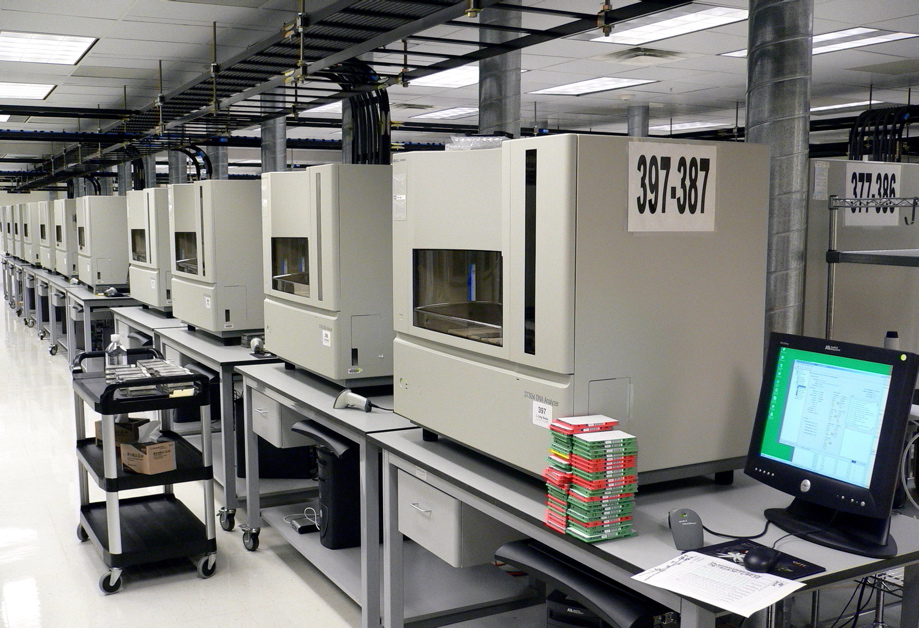
Human Genome Project.
The original idea of \u200b\u200bdecoding our entire DNA appeared in the Department of Energy of the United States, whose interests and laboratories reach far beyond the mere national energy management in the mid 80s. In a 1987 report , this ministry has already stated that his intention was "to create a physical map of human genome" and ultimately word "understand" because "the knowledge of the human genome is as necessary for the continued progress of medicine and other health sciences as knowledge of human anatomy has been for the present state of medicine." The project, with a budget of three billion dollars, was launched in 1990 as an international co-operation which also involved the United Kingdom, France, Germany, Japan, China and India.
The thing looked so promising that in 1998 he joined the private initiative of Craig Venter, led by Celera Genomics , with a budget ten times smaller (though it took a bit of cheating, including all the results already produced by the Human Genome Project that were publicly available through GenBank ). The fact is that they produce a kind of career during the latter stages of the investigation, who won the public initiative recently, the July 7, 2000.
All different, all equal.
Varmus has summarized the current situation with remarkable precision and brilliance, "Genomics is a way of doing science, not medicine." Indeed, our DNA sequencing has given us a treasure of immense value to biology ... whose medical applications practices are still very limited. We have read the genome but honestly we have not yet understood . Not enough.

hypothesis conjecture, perhaps more popular in recent times is that the differences between humans and between your chances of getting a disease or do not correspond to one or two mistakes or variations in DNA, but with a very complex sequence interactions between these subtle differences, so that obviously makes it difficult to identify and correct. For their part, environmentalists (supporters of the differences between humans and their susceptibility to disease are more closely related to the environment than genes) have found a unique opportunity to advance his view, by the simple argument that these hypotheses or conjectures deterministic remain mere speculation with the current data of the genome in hand. This will be discussed with the diseases that have a hereditary component even clearer despite living since childhood in different environments, but certainly difficult right now with those in which this hereditary factor is less secure. In light of what (little) we know now, this debate not be settled soon.
The party of biologists.
So, as my grandmother, nor as bald or seven wigs . The human genome sequencing has provided a major breakthrough biological secondary applications in medicine of this, most likely will continue to increase as we learn more. In some ways has been a disappointment, but only because Mother Nature had in store for us a puzzle even more complex and fascinating within each of our cells. And, undoubtedly, has been a principle: the birth of the future life sciences, with all the medical implications making it and will. As always, science advances until you make a mistake, we make a mistake making exaggerated promises ten years ago, but the result is we now know much more and much better. Progress is not always a straight line, but a lot of ways, including an occasional twisted back. In the long run, reading the DNA will be remembered as a great milestone and we begin to understand ourselves deeply, the better.


0 comments:
Post a Comment