The Olympus Mons on Mars presides over a series of geological monsters
leaving little ones to higher strata.

is quite known that Mount Olympus Mars, with its 27 high and 550 kilometers in diameter, is the most prominent of our solar system. However, it is not the only or even less. Several rocky planets and satellites have to be embarrassed at higher elevations most daring climber, in comparison, the Himalayas are little more than steep hills. They'll tell you would be the biggest challenges for a climber candidate for the crown-of-ten thousand more existing . At least ten years in light radius.
Mount Olympus on Mars.

his namesake, however, rises an astonishing 27 km the average surface level, with a prominence of 21,171 meters: nine times. Almost three times higher than Mount Everest, the highest peak on earth. Is thus the biggest mountain of all known anywhere.
is a volcano, it also becomes the highest volcano. Specifically, it is a shield volcano , not unlike the Mauna Loa located on the Hawaiian Islands. However, unlike the latter, appears to be off like the rest of the Martians. This is quite funny, because training is very recent: the age of the lava fields seems to oscillate between 115 and only two million years . At that time already here people walking on two legs and breaking stones with a purpose. Since there is no obvious reason for the Martian volcanism was interrupted abruptly in recent times, like one of these days we get a surprise.
The reason that a mountain of this caliber can form is that Mars, unlike Earth, has lost plate tectonics . On Earth, the continents are moving on the volcanically active areas, which appear more volcanoes but never gets to accumulate so much stuff in one place. On Mars, however, each time the magma reaches the surface it does in the same place, so the lava will accumulated over millions of years to form giants like this one or the other to be discussed later.

The rest of the way to the summit would be a quiet walk with a difference using only 2.5 º. A walk two hundred and fifty kilometers, it must be said, but mostly trekking .
must recognize that the landscape is not much: a vast expanse of volcanic nothing, and as the slope turns out to be so small, there are many scenic views. In contrast, in an atmosphere so thin to be more and more rarefied height, could rejoice every night with a breathtaking night sky as never seen eye on Earth. Yes, at between 10 and 0.3 millibars of pressure as continue rising (almost like outer space), with temperatures below a hundred degrees below zero and under intense cosmic radiation but no more dangerous that smoked half a pack of snuff day, assuming you do not use any kind of armor. In any case, the low gravity really helps carry the spacesuit and life support equipment (imagining that our mountains do not use any kind of vehicle, that's cheating).

Now if you crave the photo you envy the people and the generations for ever and ever, and for you a mountain of twenty kilometers on Mars is little challenge, I have something for you. Something special. To see if what has to be.
Iapetus' Equatorial Cordillera.

Iapetus is much smaller than the Moon, and no trick: its gravity is forty-four times less than Earth's. That means that if you carry a backpack here twenty-five kilos, there would have no problem loading a ton of material. And if here you can jump a meter, where you can jump 44.
What you need, because the challenge is not small. Iapetus has several peculiar characteristics. One of them is having two regions with a strongly differentiated albedo: a very clear (divided into Roncesvalles Earth and Earth Zaragoza) and a very dark reddish hue, which is called Cassini . And throughout Cassini is a vast range of 1300 km long crossing the Ecuador, with a height between ten and ten miles, including some elevations close to twenty thousand feet. No one knows why this gigantic mountain that looks like a belt , although there are several hypotheses. Certainly all of Iapetus landforms have names taken from the Song of Roland, which are called Sevilla, Berenguer, Cordoba and the like.
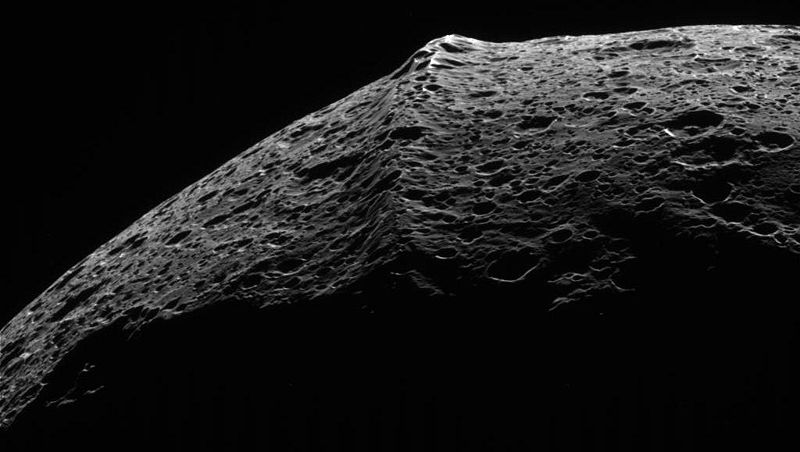
The Cordillera is a complex system composed of loose spikes, long mountains and a long region with three nearly parallel mountain ranges: Carcassonne, Toledo and Tortel. The presence of multiple craters reveals that it is very old, but is restricted to the dark: in the clear, only some loose elevations in the range of 10,000 meters.
In Iapetus There is another very notable gap, but this goes to the depths: the huge crater Turgis. Iapetus has many meteorite impacts, but none as big, with 580 kilometers in diameter, occupies nearly 40% of its surface with an escarpment ten miles down . Can anyone point to do a little rebate?
Iapetus is too small to have atmosphere and its surface temperature varies between 143 and 173 degrees below zero. As the Moon with the Earth, always shows the same face to their planet. It is the only large moon of Saturn from which the rings may look good, because the others are too close to perceive clearly.
Iapetus is too small to have atmosphere and its surface temperature varies between 143 and 173 degrees below zero. As the Moon with the Earth, always shows the same face to their planet. It is the only large moon of Saturn from which the rings may look good, because the others are too close to perceive clearly.
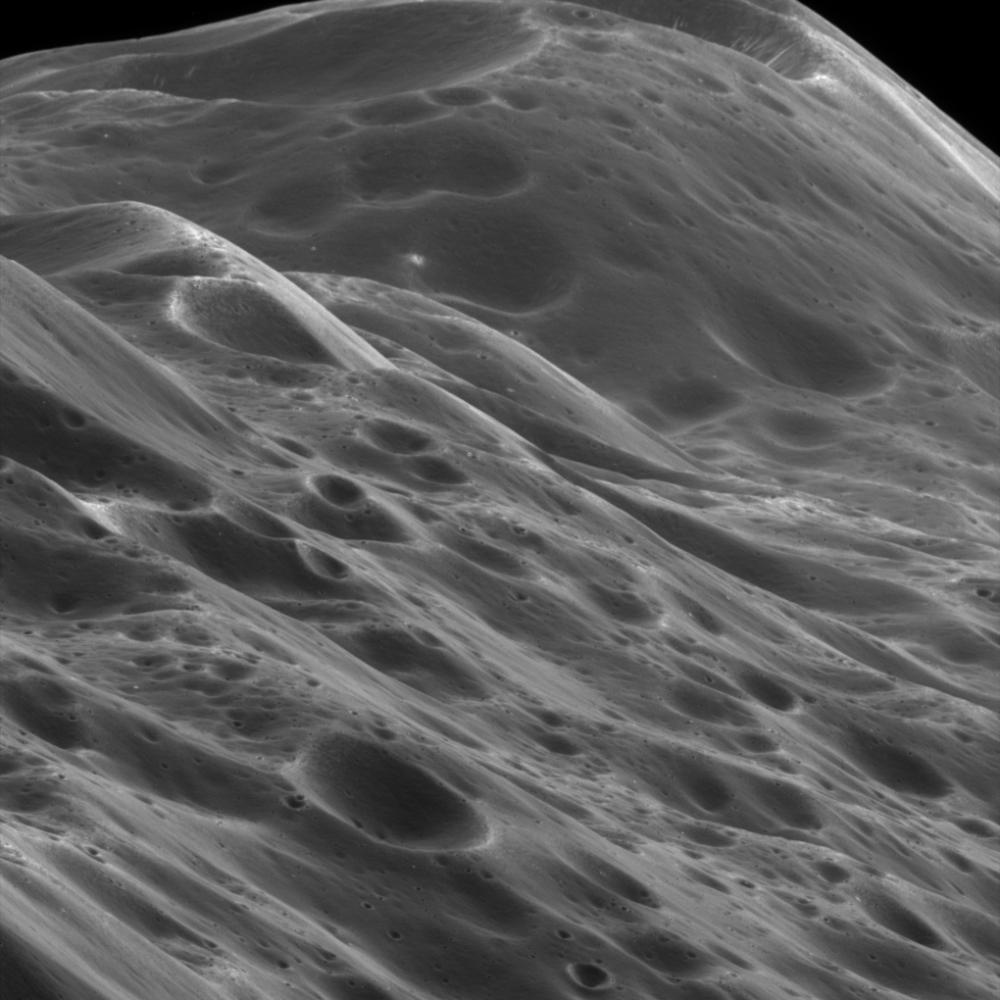
Equatorial Cordillera Iapetus, photographed by the Cassini spacecraft in 2007 to 3,870 km from the surface.
ESA - JPL / NASA

If yours is collecting peaks, returning to Mars have three other really impressive and more photogenic than the monumental but planote Olympus. Found to the southeast, in the Tharsis region . There, in a very long hill, we found three giant shield volcanoes: Ascraeus, Pavonis and Arsia.
Ascraeus, with 18 km of altitude, is itself one of the highest peaks of the solar system, is surrounded by numerous channels produced by the rivers of lava. But the Monte Arsia, Arabia Terra near , is more interesting. It rises 16 km above the average height, has a prominence of nine (like Everest or so) and has a lot of strange things. On the one hand there has been a weather phenomenon as rare, as every year, at the beginning of southern Martian winter, great clouds of dust spirals on its summit. On the other, is likely to have glaciers, although This is still under investigation. And have been counted up to seven possible caves on the slopes large (or at least potholes), this would not only delight the cavers, but opens several possibilities for the construction of permanent habitats.
The third great mountain of Pavonis Mons Tharsis is similar to above but with a dozen kilometers. North of this region is another huge shield volcano; only has six miles high, but more than 1,600 in diameter. That makes the solar system's largest by area and volume may. It is called the Monte Alba, and its crater, Alba Patera.
is believed that the volcanic formation of these clusters occurred at a time when Mars still had plate tectonics in the Noachian was , through a mechanism similar to that of the chains created by the land hotspots. Mount Olympus, in contrast, is much more modern. There are other major volcanoes in the Elysium Plains, near the Martian Ecuador. In this region might also be a great sea frozen water under a layer of volcanic ash.
Boösaule The solid, Io.
If after all this dead world and need a little ice cream action, we can go for a while Io. Io is a moon of Jupiter trapped between the immense gravitational pull of this planet, the largest in the solar system and large satellites like Callisto , Europe or Ganymede (which is almost half as large as Earth). This causes strong tidal phenomena: the bark of high tides rock is eight times larger than Earth's oceans. Tides of rock a hundred feet.

Because of all this volcanic activity on Io is one of these gigantic masses: Mount Boösaule. There's more, as Euboea, Egypt Shakur, but Boösaule is phenomenal eighteen-mile-high until the last meter sheer prominence, Io is primarily because a great plain-enhancement is the largest solar system (the closest thing to a big mountain alone in its majesty, the Mars are softer and Iapetus is a mountain range).

Boösaule and Egypt Montes, Io. New Horizons, NASA.
(Click to enlarge)
Boösaule has three peaks, called by the time North, South and This . The highest of all, who reaches eighteen kilometers, is South, but North as high as Mount Everest presents an interesting stream of several kilometers in length and depth. This , meanwhile, consists of a plateau that has two different morphological sections: a steeper western and eastern softer.

Monte Boösaule, Io. Voyager-1, NASA.
Resolution: 900 meters per pixel.
(Click to enlarge)
Io is the fourth largest moon in the solar system and orbits approximately 420,000 km of Jupiter, which in turn is about six hundred million miles from Earth. Sulfuric acid has a thin atmosphere, has auroras and their gravity is one-fifth of the land.
The Maxwell solid, Venus.

In this case, our mountaineer alien it would be even more difficult than in the past despite the proximity. Venus conditions are hellish and its gravity is very similar to terrestrial (90% of what we have here), so that these beautiful falls many feet dragging the team that would be possible in other places do not exist here .
Mount Maxwell is one of three Venusian landforms to which was not woman's name, the name is in honor of the mathematical physicist James C. Maxwell, whose work theorized the existence of radio waves (and radar). It is thanks to radar that Venus has studied in depth, and radar was what he discovered this large mass, so the name is very probably the right thing.
For those who think that all roads are already beaten, that everything is seen, there are still formidable challenges everywhere. And this is only in our solar system: who knows what we will find further! In any case, the adventure of humanity that brought us out twice in the savannas Central Africa in search of something better is not over, and even has its limits, it's just that now the borders are much farther and more accurate wet.


0 comments:
Post a Comment